Angle 7: Chinese Character "Styles" and Handwriting Samples
It may seem obvious to most of you, but it’s worth pointing out: a Chinese character doesn’t look exactly the same in every context. As with most other languages, there are variations in character fonts for print and online publication, differences in the way individuals write characters, and differences in how characters have been written over time.
Let’s look at some examples in all the following stylistic categories, using in most examples the sentence " ," (wŏ qù běi jīng), which means "I am going to Beijing."
Fonts in Print
You know already that Western languages have a variety of fonts for print, such as:

Did you know the same is true in Chinese? Just as we wouldn’t want everything to appear in  , so too does Chinese have many fonts available for paper and online publications. Here are just a few examples:

NOTE
Calligraphy
If I said that the History of European Painting represents "the art of depicting people, places, and things in color on wood and canvas," you would think that my definition is so simple that it’s useless. That’s pretty much the same, though, as saying that Chinese Calligraphy is "the art of writing poems, proverbs, and decrees on panels with fancy black characters."
In other words, Chinese calligraphy is a subject so deep and broad that it requires its own complete overview for a proper introduction.
For a token sample here, just to show you one possibility of how characters look through a calligrapher’s eyes, below is a panel from a set of paintings hanging in my home, with the "standard" appearance of the four large characters presented on the right for comparison.
Original Calligraphy | Standard Characters |
 | 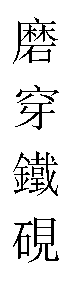 |
These characters literally mean, top to bottom, "polish through iron ink stone," and are an admonition to be diligent and persistent in order to achieve success. In ancient times, one who "polished the ink stone" was a scholar, wetting his ink stone and dipping his brush in it, probably preparing for the Imperial Exam. Passing the exam with high marks was the way to begin achieving something in Imperial China.
If you studied and wrote so much that you could wear through an ink stone even if it were made of iron, then you were working diligently enough. Good advice even today.
Handwriting
Have you wondered how everyday handwriting looks in Chinese, how people write when they’re doing their homework, writing a letter to a friend, or jotting down a shopping list?
And would you have guessed that Chinese has both script and cursive writing styles too? They’re called  (kăi shū) for standard calligraphy style and
  (căo shū) for cursive calligraphy style.
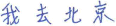
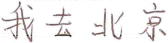
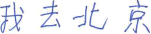
I asked some friends and relatives whose first language is Chinese to write in standard and cursive styles for us. Here are the results, along with their genders and approximate ages to make it a little more interesting.
Let’s look at samples written by girls and women first.
Handwriting Samples: Girls and Women
Standard Style ( | Cursive Style ( | Age |
 |  | 10-14 |
 |  | 20’s |
 |  | 30’s |
 |  | 50’s |
 |  | 60’s |
 |  | 60’s |


With English or your native language, can you tell if handwriting is from a woman or a man? Do you think there will be any major differences between how men and women write in Chinese? Here’s your chance to find out?
Handwriting Samples: Boys and Men
Standard Style ( | Cursive Style ( | Age |
 |  | 20’s |
 |  | 30’s |
 |  | 30’s |
 |  | 30’s |
 |  | 40’s |
 | 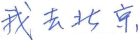 | 40’s |
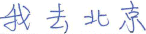 |  | 50’s |

Stylistic Evolution
Finally, as Diana Lavarini & Anna Del Franco point out on their site Sinophilia, characters have been undergoing a sort of stylistic evolution for centuries. Diana and Anna have provided the illustration below to prove it using one character from , the  (qù), which means go.
The original pictograph, they point out, showed a man going out of his cave. Note that modern characters most resemble the fifth example below, the Exemplar style.
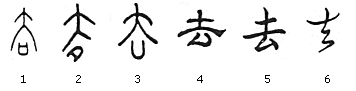
Left to right, these examples are:
- Carving found on an Oracular Bone
- An Inscription found on Bronze work
- Small Seal Style
- Administrative Style
- Exemplar Style
- Cursive Style (
 căo shū)

 Malay
Malay  English
  French
  German
  Thai
Thai  Vietnamese
  Myanmar